Help for a Reactive or Aggressive Dog in Anaheim
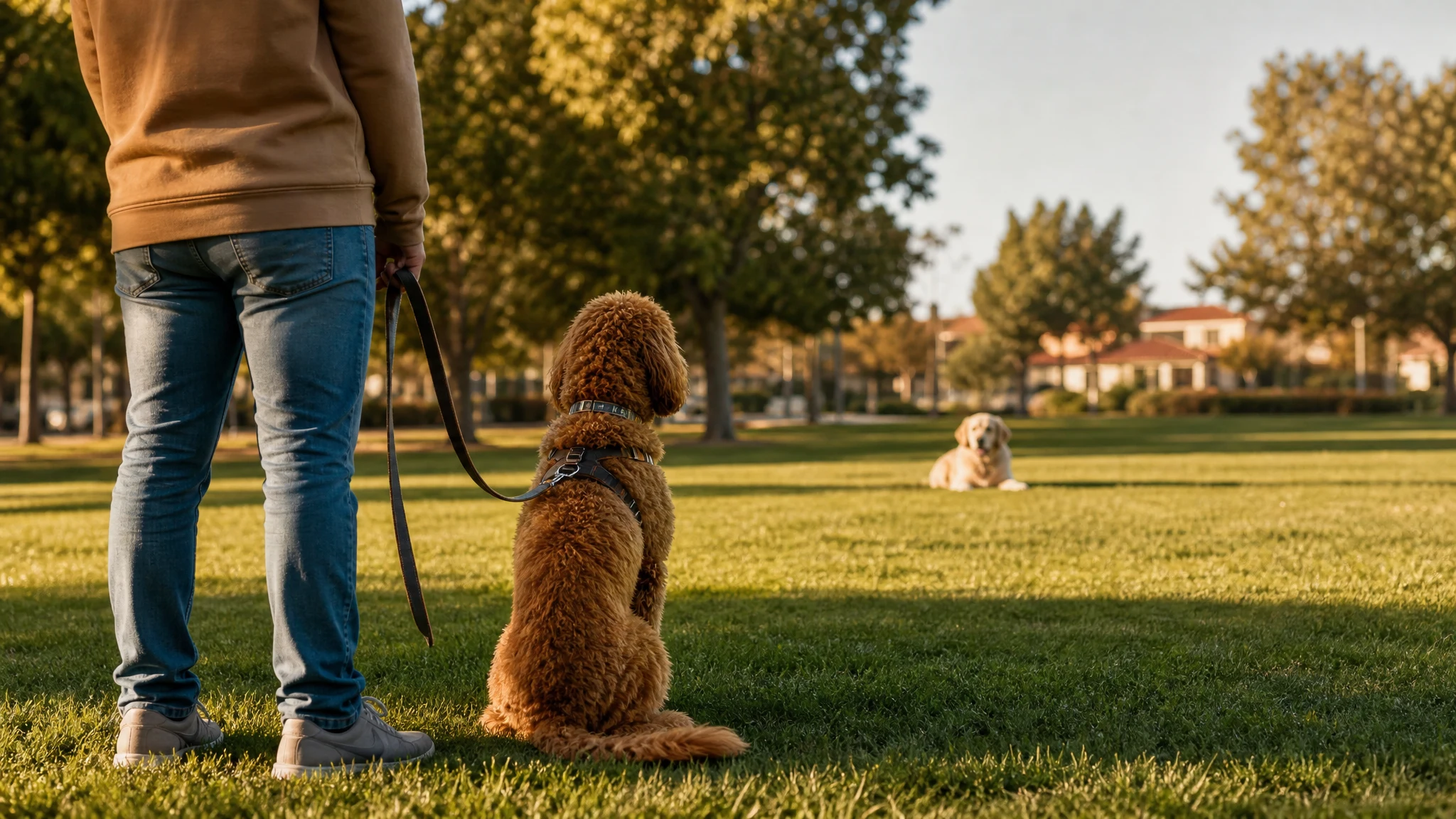
General training information. For aggression, sudden behavior changes or health concerns, see your veterinarian first.
If your dog lunges at other dogs on a walk around the neighborhood, barks wildly at strangers, or has snapped at someone, you are not alone. It is stressful, and it can make you dread opening the front door. The good news is that many dogs improve when owners use a calm, reward-based plan and get the right professional help early.
This guide walks through reactive dog training at home, step by step, with Anaheim in mind: leash rules, dog parks, summer heat, and where to look for qualified help.
What reactivity and aggression actually are
A reactive dog overreacts to a trigger, such as another dog, a bike, a stranger, or a skateboard. The reaction often looks big: barking, lunging, growling, spinning at the end of the leash. Underneath, it is usually fear, frustration, or overexcitement.
Aggression is behavior meant to increase distance or cause harm, such as snarling, snapping, or biting. Reactivity can lead to aggression if a dog feels trapped and nothing else works. But the two are not the same, and they do not always call for the same response.
Here is a useful rule of thumb. If your dog barks and lunges but has never made contact with a person or another dog, you are likely dealing with reactivity. If your dog has bitten, or you are afraid of what could happen, treat it as a safety issue first and a training project second.
Safety comes first
Before any training, make the situation safe. Training only works if nobody gets hurt while you do it.
- Manage the setting. Keep your dog away from triggers you cannot control. Close curtains, use a gate, or move your dog to another room when guests arrive.
- Know the leash rule. OC Animal Care, which provides field services for Anaheim, summarizes Orange County Code 4-1-45: on public property a dog must be on a substantial chain or a leash of 6 feet or less, under the charge of a competent person. A short, secure leash is also simply safer for a reactive dog.
- Skip the off-leash dog parks for now. Anaheim has designated dog parks, which are the lawful off-leash exception, but a reactive or aggressive dog is a poor fit for a space full of unfamiliar dogs.
- Never leave your dog loose around visitors or children if there has been any bite or bite attempt.
Anaheim's dangerous dog rule
It helps to know where the legal lines are. OC Animal Care's pet laws page lists Orange County Code 4-1-23, which defines potentially dangerous and vicious dogs, and 4-1-95, which covers the declaration and the restrictions placed on such dogs. The page only summarizes these sections, so read the full county text or ask OC Animal Care how it applies to your situation.
The California Food and Agricultural Code, section 31602, also defines a potentially dangerous dog. One example is a dog that, twice within 36 months, unprovoked, causes a person to take defensive action off the owner's property.
The practical message is simple. A dog that threatens or bites people off your property can bring legal trouble as well as risk. If your dog has bitten someone, contact OC Animal Care at 714-935-6848 (1630 Victory Road, Tustin) or check its website to understand your obligations, and talk to your veterinarian right away.
Why punishment makes it worse
When a dog growls, it is giving a warning. Punishing that warning does not remove the feeling behind it. It only teaches the dog to hide the warning, and the next step can be a bite with no notice.
The American Veterinary Society of Animal Behavior (AVSAB) advises that reward-based training is the safer, more effective approach, and that punishment can increase fear, anxiety, and aggression. Yelling, leash jerks, or any tool that hurts or frightens your dog can make the trigger feel even scarier. Your dog learns that dogs or people predict pain, which is the opposite of what you want.
Avoid alpha rolls, scruffing, and "dominance" methods too. They are not supported by current behavior science, and they put your hands near a dog who may bite.
What you will need
- A flat collar or a well-fitted harness, plus a 6-foot leash (never a retractable one)
- Small, soft, high-value treats your dog loves, cut pea-sized, such as cooked chicken or cheese
- A treat pouch so rewards come fast
- A secure fence or baby gate for managing your home
- A comfortable mat or bed for settling practice
- A notebook to log triggers, distances, and your dog's body language
- A water bottle for you and your dog, especially in summer
Step-by-step: desensitization and counter-conditioning
These two ideas are the backbone of most reactivity plans. Desensitization means exposing your dog to a trigger at a level so low it does not cause a reaction. Counter-conditioning means pairing that trigger with something wonderful, so the dog slowly learns "that thing means treats."
Step 1: Find your dog's threshold distance
The threshold is the distance at which your dog notices a trigger but can still eat treats and respond to you. Stand far from the trigger, such as another dog across a wide parking lot or street. If your dog stiffens, stares, barks, or refuses food, you are too close. Back up until they can relax.
Write down that distance. It is your starting line, and it may be farther than you expect. That is normal.
Step 2: Learn your dog's body language
Look for early signs of stress: a hard stare, a closed mouth, stiff body, raised hackles, lip licking, or yawning. Catching these early lets you create distance before your dog explodes. Reacting late is one of the most common reasons plans stall.
Step 3: Pair the trigger with food
While your dog is below threshold, the moment they see the trigger, start feeding treats. Keep feeding while the trigger is in view. When it leaves, the treats stop. The order matters: trigger appears, treats start. Trigger disappears, treats end.
Do not wait for your dog to look away or "be good" before rewarding. At this stage, you are changing feelings, not asking for a behavior.
Step 4: Practice "look at that"
Once your dog is relaxed at your starting distance, you can let them glance at the trigger, then mark with a calm "yes" and give a treat when they look back at you. Over many sessions, your dog learns that seeing a trigger is a cue to check in with you.
Step 5: Add distance practice, slowly
Only when your dog stays relaxed for several sessions should you move a little closer, perhaps a few steps. If the reaction returns, go back to the last easy distance. Progress is rarely a straight line, and that is fine.
Step 6: Teach an escape route
Practice a cheerful U-turn. Say "this way," turn, and walk away while feeding treats. This gives you a calm way out of a tricky moment without dragging your dog. Practice it often in easy settings so it works when you need it.
Step 7: Build calm at home
Reward your dog for settling on a mat, chewing a safe chew, and resting. A dog who is well rested and gets enough mental exercise tends to cope better with triggers. Keep sessions short, about 5 to 10 minutes, and end while your dog is still doing well.
Anaheim-specific things to plan for
- Pick quiet times and places. Early morning or late evening walks usually mean fewer surprise dogs and joggers.
- Watch the heat. OC Animal Care warns that asphalt can burn a dog's paws: at a 77 degree air temperature the asphalt is already 125 degrees, and skin destruction can occur in 60 seconds. It also advises never leaving a pet in a car and always providing water and shade. A stressed, overheated dog is even harder to train, so shift sessions to cooler hours.
- Wildlife can be a trigger. OC Animal Care lists coyotes and snakes among the wildlife residents may see, and bobcats, foxes and mountain lions near open spaces. If your dog reacts to animals, keep the leash short and avoid brushy edges at dawn and dusk.
- Be a good neighbor. Anaheim is listed by OC Animal Care under Adopted Ordinance Cities for barking dog complaints. A barking dog is defined as one that barks incessantly for 30 minutes or more in any 24-hour period, or intermittently for 60 minutes or more in 24 hours. Complaints go to the OC Animal Care Barking Dog Program at (714) 796-6442. If a reactive dog barks at the window all day, block the view and give them something calming to do.
Tips for success
- Go slower than you think you need to. Rushing is the biggest cause of setbacks.
- Keep treats better than the trigger. If your dog ignores food, you are probably too close or the treat is not exciting enough.
- Stay calm. Dogs read your tension through the leash. Breathe, relax your shoulders, and keep your voice soft.
- Celebrate small wins. A dog who glances at a trigger and then looks at you has made real progress.
- Be consistent. Everyone in the household should use the same plan.
Common mistakes to avoid
- Letting your dog "say hello" to every dog. Greeting on leash can raise tension quickly.
- Correcting growls. A growl is useful information, not bad manners.
- Flooding, which means forcing your dog to stay near a trigger until they "get over it." This usually backfires.
- Using a retractable leash, which gives you less control and can startle your dog.
- Skipping the vet. Pain and illness often sit behind sudden behavior changes.
- Training only when a trigger shows up by surprise. Set up planned practice sessions instead.
When to see a veterinarian or a veterinary behaviorist
Start with your veterinarian whenever behavior changes suddenly, gets more intense, or involves any aggression. Pain, thyroid problems, and other medical issues can make a dog far more reactive. A vet can rule these out and talk about whether medication might help your dog learn more calmly.
If your dog has bitten or threatened people, see a veterinarian and work with a certified behavior professional. Ask your veterinarian for a referral to a veterinary behaviorist, who is a veterinarian with advanced training in behavior, if the problem is serious or not improving. Do not try to manage aggression toward people on your own with online videos alone.
Contact your veterinarian immediately if your dog is injured, in pain, or showing sudden, severe behavior changes.
Finding local help
I do not have a confirmed behavior consultant based in Anaheim to point you to, so check with your veterinarian and ask for a referral.
For trainers, the Certification Council for Professional Dog Trainers (CCPDT) keeps a public certified dog trainer directory for California. These listings from that directory are in neighboring cities, not Anaheim itself:
- Debbie L. Perry, Orange, CA 92821
- Amanda K. Farah, Placentia, CA 92870
- Gretchen Mavrovouniotis, Tustin, CA 92780 (Wags & Wiggles is listed as her business on DogTrainerLocator)
- Tamlyn Rika Asari, Tustin, CA 92780
The directory covers several credentials, and the list page does not show which credential each person holds. Open the directory to confirm details, then ask any trainer how they handle reactivity and aggression, and whether they use only reward-based methods. A trainer who guarantees a quick fix or uses pain or fear is not a fit. For fees, class types, and what to ask before you book, see our guide to dog training in Anaheim, where to train and what it costs.
What results to expect
Every dog is different, so no one can promise an outcome. Many dogs become calmer and more manageable with steady practice, though progress often takes weeks to months. Some dogs will always need management, such as extra distance or a muzzle-conditioning plan guided by a professional, and that is a perfectly good outcome.
You may notice that your dog recovers faster after a trigger, looks to you more often, and can handle smaller distances without reacting. Setbacks happen and do not mean you have failed. Keep your sessions short, keep the rewards flowing, and call in professional help when you need it.