Off-Leash Dog Parks in Anaheim and How to Train for Them
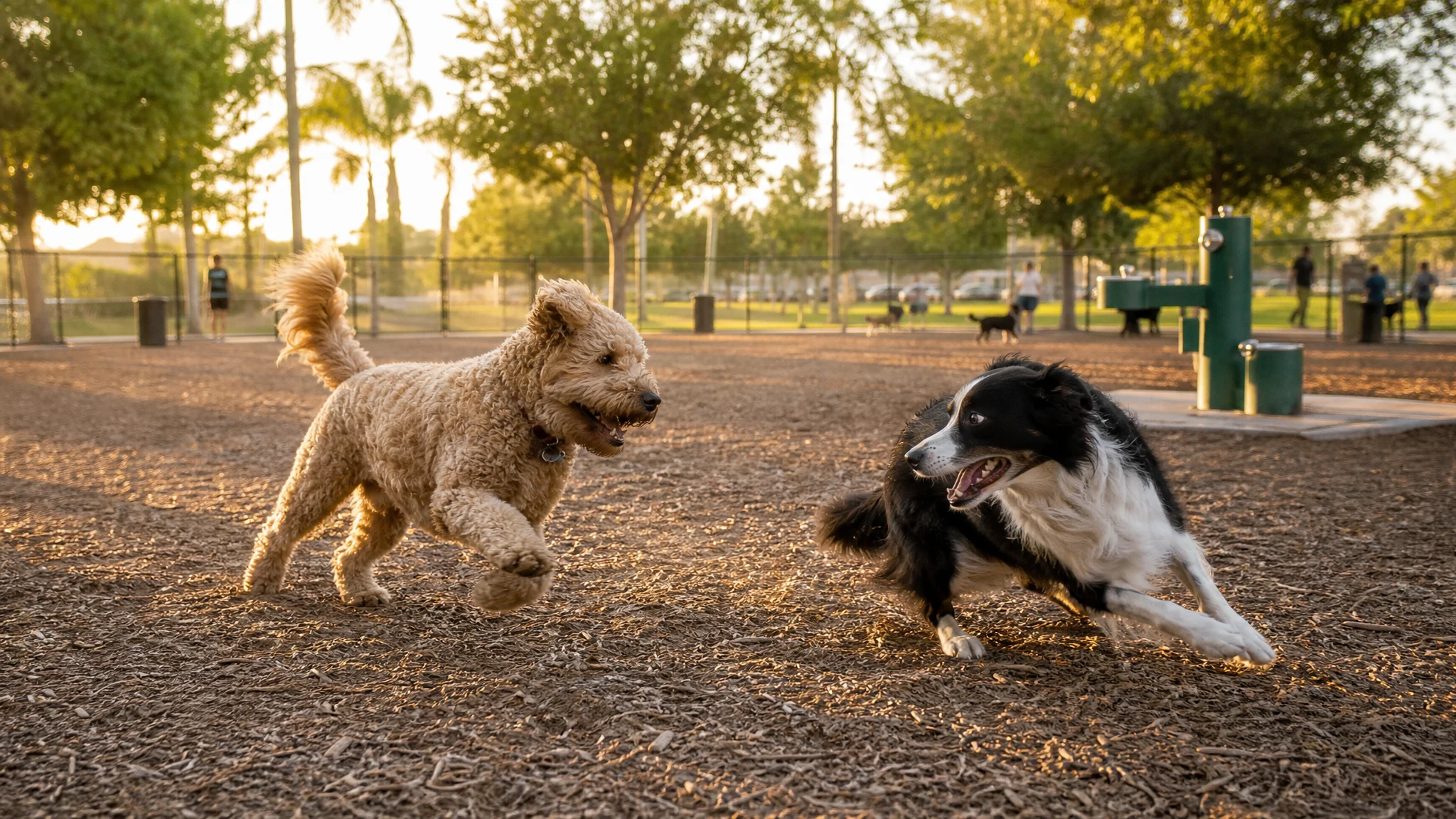
General training information. For aggression, sudden behavior changes or health concerns, see your veterinarian first.
An off-leash run is one of the best things you can give a dog. It is also one of the easiest places for a dog to learn bad habits. A dog who bolts through the gate, ignores your voice and mobs every newcomer is practicing the wrong lessons at full speed.
This guide covers the dog parks in Anaheim and the rules that apply to them. Then it walks through the skills a dog needs before the gate opens: coming when called, checking in, reading play, and leaving calmly. It ends with the dogs who are better off somewhere else.
The Off-Leash Dog Parks in Anaheim
If you want an off leash dog park near Anaheim, you have four to know about inside the city. These details come from the Enjoy Orange County dog park directory. Hours and addresses change, so confirm them with the City of Anaheim before you drive over.
| Park | Address | Hours and notes |
|---|---|---|
| Olive Hills Dog Park | 700 S Nohl Canyon Road, Anaheim, CA 92807 | Open daily, dawn to dusk. Separate small and large dog areas. |
| Maxwell Dog Park | 2650 W Broadway, Anaheim, CA 92804 (some listings say 2660 W Broadway) | 5 AM to 10:30 PM, closed Wednesdays from 5 AM to noon for maintenance. Separate large and small dog areas. |
| La Palma Park Dog Park | 229 W La Palma Ave, Anaheim, CA 92801 | Open dawn to dusk. Separate small and large dog areas. |
| Jacaranda Park Dog Park | 1955 S. Jacaranda Street, Anaheim, CA 92805 | Hours not listed. Separate small and large dog areas. Smaller than the other Anaheim dog parks. |
The directory does not list a fee for Olive Hills. For fees, posted park rules and any closures, check with the City of Anaheim.
Because Maxwell's address appears two ways, use the cross streets or a map app on your first visit. A short walk past the wrong gate is a poor way to start with a dog who is already excited.
The Rules That Apply Off the Grass
Dog parks are the exception to the leash rule, not a sign that the rules have gone away. OC Animal Care, which provides field services for Anaheim, summarizes Orange County Code 4-1-45 this way: on public property a dog must be on a substantial chain or a leash of 6 feet or less, under the charge of a competent person. Designated dog parks are the lawful off-leash spots.
That means the walk from your car to the gate is a leash walk. So is the sidewalk, the trail and the rest of the park outside the fence. Your dog needs to be able to walk politely on a 6-foot leash before off-leash time is worth considering.
Two more items to settle before your first visit:
- Licensing. OC Animal Care's pet laws page says every dog 4 months or older must be licensed, the license renews every year, and a current rabies vaccination certificate is needed to buy one. There is a reduced fee for spayed or neutered dogs. For the current fee, ask OC Animal Care directly.
- Rabies vaccination. California Health and Safety Code section 121690 says that once a dog is 3 months old, the owner must have it vaccinated against rabies by a licensed veterinarian. The county code uses 4 months, so follow the stricter state age.
Your dog will also need the puppy vaccines your veterinarian recommends before meeting unfamiliar dogs. Ask your vet when your own puppy is ready for shared spaces.
What You Need Before You Start
- A flat collar or a well-fitted harness and a 6-foot leash.
- A 15 to 30 foot long line for recall practice. Use it with a harness, not a collar, so a sudden stop does not strain the neck.
- A treat pouch with small, soft, high-value treats. Cut them pea-sized so you can reward many times without filling your dog up.
- A second, more exciting treat for the hardest moments, such as cooked chicken or cheese.
- Waste bags and a collapsible water bowl.
- A quiet practice spot: your yard, a hallway or a low-traffic corner of a park.
Leave anything that pinches, prongs or shocks at home. Humane, reward-based training is what the American Veterinary Society of Animal Behavior (AVSAB) supports. It also works better for off-leash reliability, because a dog who enjoys coming to you will come more often than a dog who fears what happens when you catch them.
Step-by-Step: Training for the Dog Park
Step 1: Teach a recall you can trust
A recall is the one skill that matters most off leash. Choose a word you will only use for this, such as "here." Do not use your dog's name as a scolding word, and never call your dog to do something unpleasant.
- Start indoors with no distractions. Say the word once in a happy voice, then feed a treat the moment your dog arrives.
- Repeat 5 to 10 times per session, a few sessions a day. Keep each session short.
- Move to the yard on the long line. Call, reward generously, then release your dog back to sniffing. That release teaches that coming to you does not end the fun.
- Add distance a few feet at a time. If your dog hesitates, make yourself more interesting by crouching, backing up or clapping, then reward big when they arrive.
- Add distractions slowly: a toy on the ground, then a family member, then a walk-by at a distance.
Call only when you think your dog will succeed. If you call and your dog ignores you, do not repeat the word again and again. Walk calmly, gather the line and try an easier version next time.
Step 2: Build the check-in habit
A dog who checks in with you on their own is far easier to manage in a busy space. You are teaching your dog that looking at you pays off.
- On a leash, wait for your dog to glance at you. The instant they do, say "yes" and give a treat.
- Repeat on walks until your dog starts looking back more often without being asked.
- Practice near mild distractions, like a bicycle across the street or a neighbor's dog at a distance.
- Later, practice on the long line in open spaces. Reward every voluntary check-in.
At the dog park, this habit lets you notice when your dog is getting overwhelmed and step in early.
Step 3: Practice leaving things calmly
Dog parks have dropped food, other people's toys and tempting scents. A solid "leave it" keeps your dog safer and your trips calmer.
- Hold a treat in a closed fist. Let your dog sniff and lick without opening it.
- The moment your dog backs off or looks away, say "yes" and give a different treat from your other hand.
- Progress to a treat on the floor under your hand, then a treat on the floor uncovered while your dog is on leash.
- Always reward from your hand, not from the item your dog left alone.
Step 4: Learn to read dog play
This step is for you, not your dog. Many dog park problems start because a person misses the early signs that play has tipped into stress.
Healthy play usually looks loose and bouncy. Dogs trade roles, with one chasing and then the other. They take breaks, sneeze, shake off and then start again. Their bodies look wiggly, not stiff.
Watch for signs of trouble:
- One dog is always being chased and never gets to chase back.
- A dog tucks the tail, hides behind you or tries to leave the group.
- Bodies go stiff, the stare gets hard or the mouth closes tight.
- Several dogs pile onto one dog.
- Your dog cannot pause. Wild, frantic play with no breaks can boil over quickly.
If you see these, call your dog away, give a break outside the gate and decide whether to try again. Leaving early is not a failure. It is how you protect your dog's trust in you.
Step 5: Rehearse the gate routine
Excited dogs rush gates, and the entry area is where scuffles often begin. Practice the routine at home first.
- Ask for a sit at the door or car, then reward.
- Walk to the entry on a loose leash. Stop before the gate and wait for a calm moment.
- Enter the double-gate area, close the first gate, then unclip the leash only when your dog is settled.
- When it is time to leave, call your dog, clip the leash and reward before you walk out.
Practicing the leave is as important as the arrival. If every visit ends with a chase around the park, leaving becomes something your dog avoids.
Step 6: Make the first visit short and quiet
Pick a time when the park is usually calmer. Use the separate small and large dog areas that each Anaheim park offers, and choose the one that fits your dog's size and comfort. Stay for 10 or 15 minutes, keep your dog close, and leave while things are still going well.
Build up over several visits. Check in often, watch play closely and keep your treats ready.
Common Mistakes to Avoid
- Skipping recall practice. Hoping your dog will come because it "usually" does is risky once other dogs are involved.
- Calling your dog to end the fun every time. If recall always means leaving, your dog learns to ignore it. Mix in plenty of calls that end with a treat and a quick return to play.
- Scrolling on your phone. Early signs of trouble last seconds. Stay close and keep your eyes up.
- Bringing food or toys without thinking. Treats and toys can start a conflict. Keep treats in a closed pouch, and check the posted rules for toys.
- Using the park to fix a problem. A dog park does not cure leash reactivity, fear or poor manners. It tends to make them more visible.
- Punishing a late return. If you scold your dog when they finally come, you teach them not to come next time.
Anaheim Hazards to Keep in Mind
Heat is the big one. OC Animal Care warns that asphalt can burn a dog's paws. At a 77 degree air temperature, the asphalt can already be 125 degrees, and skin damage can occur in 60 seconds. Check the pavement in the parking lot with the back of your hand before you walk across it. The agency also advises never leaving a pet in a car and always providing water and shade.
OC Animal Care's wildlife information page lists coyotes and snakes among the wildlife residents may see, with bobcats, foxes and mountain lions near open spaces. The Olive Hills area sits closer to canyon country than the city center parks, so keep your dog within sight and never leave a small dog unattended near open areas, especially at dawn and dusk.
What to Expect
Every dog learns at a different pace. With short, regular practice, many dogs begin to respond more reliably in quiet places within a few weeks. Reliable behavior around distractions and other dogs usually takes longer, and some dogs need months of steady work. Age, history and temperament all play a part, so treat these timelines as a rough guide, not a promise.
You may notice your dog checking in more often and recovering faster after excitement. You may also find you read the park better, and that is a skill that helps every visit.
When a Dog Park Is Not Right for a Dog
Not every dog enjoys a dog park, and that is fine. A dog park may not be a good fit if your dog:
- Is still a young puppy who has not finished the vaccinations your veterinarian recommends.
- Is not yet vaccinated for rabies as California law requires.
- Guards food, toys, or you around other dogs.
- Is fearful, tries to hide or freezes when dogs approach.
- Is in heat, or is unwell or recovering from surgery.
- Cannot be called away from distractions even in a quiet yard.
Other options can meet the same needs. Sniff-heavy leashed walks, hide-and-seek games, tug and fetch in your own yard, and one-on-one meetups with a calm, known dog all give exercise and fun without the crowd.
If your dog growls, snaps or bites people or other dogs, skip the dog park for now. Aggression toward people needs a veterinarian first, to rule out pain or illness, and then a certified behavior professional. If you suspect a medical problem, such as sudden changes in mood, limping or heavy panting, see your veterinarian promptly.
A few legal points are also worth knowing. OC Animal Care says Orange County Code 4-1-23 defines potentially dangerous and vicious dogs, and section 4-1-95 covers the declaration and restrictions. California Food and Agricultural Code section 31602 also defines a potentially dangerous dog. If a bite or serious incident happens, contact OC Animal Care for the specifics.
Also remember that OC Animal Care lists Anaheim under its adopted ordinance cities for barking dog complaints. Excited barking at home after park trips can add up, so give your dog quiet time to settle.
Getting Help
If recall is stuck or your dog gets overwhelmed, a class or a private session can save weeks of frustration. For a look at local options and what to ask, read our guide to dog training in Anaheim, where to train and what it costs. You can also browse the CCPDT certified dog trainer directory for California and ask any trainer how they train and which methods they use. Look for reward-based methods.
For licensing, field services or lost and found pets, OC Animal Care operates from 1630 Victory Road, Tustin, CA 92782, phone 714-935-6848.
Sources
- OC Animal Care, OC Pet Laws
- OC Animal Care, Barking Dog & Animal Nuisance Complaint Process
- OC Animal Care, Be Careful, the Ground May Be Hot!
- OC Animal Care, Wildlife Information
- County of Orange, OC Animal Care location page
- California Health and Safety Code section 121690
- Enjoy Orange County, Dog Parks
- CCPDT, Certified Dog Trainer Directory, California