Training Your Dog for Anaheim's Weather and Terrain
General training information. For aggression, sudden behavior changes or health concerns, see your veterinarian first.
Anaheim is a great place to walk a dog. It also has hot sidewalks, sunny afternoons and open spaces where wildlife lives. A little training makes those things easier to handle.
This guide walks you through building a few habits: leaving things alone, coming when called, letting you handle your dog's paws, and settling into a cooling routine. Each step ties back to a hazard that Orange County's animal agency has written about. If you are still deciding where to train, our guide to dog training in Anaheim, where to train and what it costs is a good companion to this one.
What you will need
- A leash of 6 feet or less. Orange County Code 4-1-45, as summarized by OC Animal Care, requires a substantial chain or a leash of 6 feet or less on public property, with a competent person in charge of the dog.
- A well-fitted flat collar or a harness.
- Small, soft, high-value treats your dog loves.
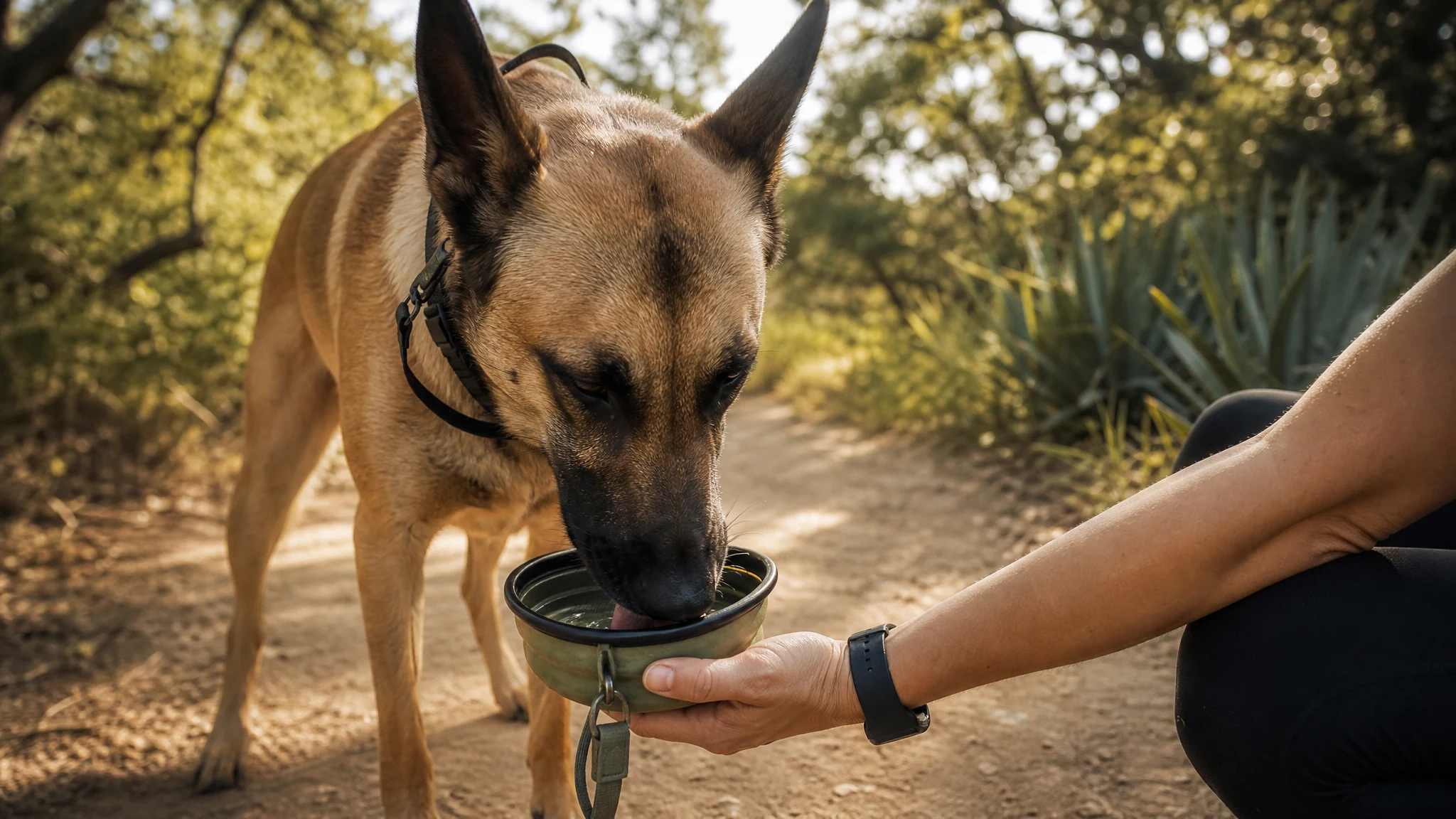
- Fresh water and a collapsible bowl for every outing.
- A towel for wiping paws and cooling your dog down at home.
- Optional: dog booties, if your dog will accept them (Step 5 covers how).
- A few minutes of patience, several times a week.
Everything here uses rewards. This matches the approach recommended by the American Veterinary Society of Animal Behavior (AVSAB). Skip anything that relies on pain or fear, such as shock, prong or choke collars. They can damage trust, and they are not needed for any step below.
Why Anaheim walks need extra planning
Two hazards are documented by OC Animal Care for our area: hot ground and wildlife. Both can be softened with training, but training does not replace common sense. Choose cooler times of day, bring water and keep your dog close.
Hazard 1: hot pavement and summer heat
OC Animal Care, in its notice "Be Careful, the Ground May Be Hot!", warns that asphalt can burn a dog's paws. At an air temperature of 77 degrees, the asphalt can already be 125 degrees. The agency says skin destruction can occur in as little as 60 seconds.
That is why walking a dog in heat takes thought. A day that feels pleasant to you can still be hard on bare paws. OC Animal Care also advises never leaving a pet in a car and always providing water and shade.
Hazard 2: coyotes and other wildlife
OC Animal Care's wildlife information page lists coyotes and snakes among the wildlife residents may see. It also lists bobcats, foxes and mountain lions near open spaces. If your routes run near open space or the edge of a neighborhood, plan for the chance of an encounter.
The best protection is a dog who stays near you and listens when you ask.
Step-by-step: training for Anaheim's heat and terrain
Step 1. Build a pavement check into every walk
This one is for you, not your dog. Before you leave, press the back of your hand on the sidewalk or street. If it feels too hot to hold there comfortably, it is too hot for paws.
Given the temperatures OC Animal Care describes, you cannot judge by the air alone. Asphalt can be much hotter than the air above it. Pick shaded routes, grass or dirt where it is allowed, and walk early in the morning or after the sun has dropped.
Make the check part of your routine. Pause at the front door, check the ground, and say a cheerful cue like "let's go." Your dog learns that this pause leads to something good.
Step 2. Teach a relaxed paw touch
Dogs who dislike having their feet handled make hot-weather care harder. You want to be able to look at and wipe paws easily.
- Sit on the floor with your dog when they are calm.
- Touch one shoulder, then give a treat.
- Slide your hand down the leg a little at a time. Reward each small step.
- Touch a paw for one second, then treat. Let go before your dog pulls away.
- Gradually hold the paw longer, then gently touch between the pads.
Keep sessions to a minute or two. If your dog stiffens or tugs away, go back to an easier step. Over time, this makes it simpler to notice a sore pad, wipe your dog's feet after a walk, or fit booties.
Step 3. Teach a cooling-down settle
After a walk, a calm routine helps your dog rest instead of racing around the house. Pick a spot in a cool, shaded room. Put a mat or towel there.
- Lure your dog onto the mat with a treat and say "settle."
- Reward when all four paws are on it.
- Reward again when your dog lies down.
- Offer fresh water nearby.
- Keep practicing in short sessions until your dog heads to the mat on cue.
This gives you a predictable way to end each outing. It also makes it easier to see how your dog is doing, because a dog who is settled is easier to watch than one who is bouncing off the walls.
If your dog seems overheated, weak or unwell, do not wait for training to fix it. Call a veterinarian right away.
Step 4. Teach a strong "leave it"
A reliable "leave it" helps with many outdoor hazards, from dropped food to dead animals to critters in the brush. It is the main skill that helps when wildlife is nearby.
- Hold a treat in a closed fist. Let your dog sniff and paw at it.
- The moment your dog backs off, even for a second, say "yes" and give a different treat from your other hand.
- Repeat until your dog turns away from the fist on their own.
- Next, put the treat on the floor under your hand, then uncover it a little at a time.
- Finally, practice with real items on walks, always rewarding with something better than what they left.
Practice at home first, then in the yard, then on quiet streets. Raise the difficulty slowly.
Step 5. Introduce booties slowly, if you choose to use them
Booties are optional, and many dogs never need them if walks stay on cool ground. If you want your dog to accept them, take it in tiny steps.
- Let your dog sniff a bootie and give a treat.
- Touch the bootie to a paw and treat.
- Put on one bootie for a few seconds, treat, and remove it.
- Slowly work up to all four, worn indoors while you play or feed meals.
- Take a short walk on a cool surface before ever wearing them in warm weather.
Booties are not a license to walk on hot ground. A bootie does not make a very hot surface safe, so keep checking the pavement and the weather. If your dog walks oddly or chews at them, stop and try again later or skip them.
Step 6. Build a recall for open spaces
A dog who comes when called is easier to protect near wildlife. Choose a happy word, like "here," and use it only for good things.
- Indoors, say the word in a bright voice and step back. When your dog arrives, give a treat.
- Practice in more rooms, then in the yard on a long line.
- Add distractions slowly: a toy, a person, a smell.
- Always reward generously. Never call your dog to scold them.
On public property, keep your dog leashed as the county rule requires. The lawful exception is a designated dog park. Anaheim has several, including Olive Hills Dog Park, Maxwell Dog Park, La Palma Park Dog Park and Jacaranda Park Dog Park, according to Enjoy Orange County. Hours and addresses can change, so confirm with the City of Anaheim before you go. Listings show Maxwell open 5AM to 10:30PM with a weekly Wednesday morning maintenance closure, and Olive Hills open dawn to dusk. Check the city for current details.
Step 7. Practice a calm check-in on leash
Because your dog should stay on a 6-foot leash outside of dog parks, teach them to look at you on cue. This helps when you spot a coyote or another animal at a distance and need to turn around.
- Say your dog's name. When they look at you, say "yes" and treat.
- Repeat in different places, starting with easy ones.
- Add a turn: say "this way," walk the other direction, and reward your dog for following.
This gives you a polite, calm way to leave a situation without pulling or yanking.
Tips for success
- Train in short sessions of a few minutes. Dogs learn better when they are not tired or hot.
- Practice the cooling mat and paw touch indoors on warm days, when you cannot walk.
- Carry water on every outing, even short ones.
- Keep treats small so you can do many repetitions.
- Pick your walk times by the ground, not just by the clock.
- If you are unsure about a hazard in your area, ask OC Animal Care, which provides field services for Anaheim.
Common mistakes to avoid
- Judging heat by the air. OC Animal Care notes that asphalt can reach 125 degrees when the air is 77. Check the ground itself.
- Leaving a dog in a parked car. OC Animal Care advises against it, even for a quick errand.
- Skipping water and shade. Both are on the agency's list of basics.
- Letting a dog off leash outside a dog park. The county rule asks for a leash of 6 feet or less on public property.
- Rushing booties. Forcing them on can make your dog dislike them.
- Using punishment. Corrections can make a nervous dog more fearful and do not teach what to do instead.
- Training only when there is a problem. Short, regular practice works better than a rush before a hard walk.
What to expect
With steady practice, many dogs become calmer about paw handling, more willing to settle after a walk, and more responsive to "leave it" and recall. Some dogs may learn faster than others. Age, past experiences and temperament all play a part, and results vary from dog to dog.
These skills may make hot-weather routines smoother and could help you respond if wildlife appears. They do not remove the risks. Heat, hot ground and wild animals remain real concerns, so keep using good judgment on every outing.
When to get extra help
If your dog seems unwell after being outdoors, or you think they may be overheated or hurt, call a veterinarian promptly. If your dog shows aggression toward people, talk to a veterinarian first, because pain or illness can play a role. Then work with a certified behavior professional.
If you want a trainer, the CCPDT keeps a public certified dog trainer directory for California. You can search it for someone near you and ask about their methods. Choose a trainer who uses rewards and who is open about how they teach.
Other hazards, such as foxtails, valley fever, algae in water, or cold and salt, are not covered here. If you are concerned about one, ask your veterinarian or OC Animal Care.