Certified Dog Trainers in Anaheim: Credentials and How to Choose
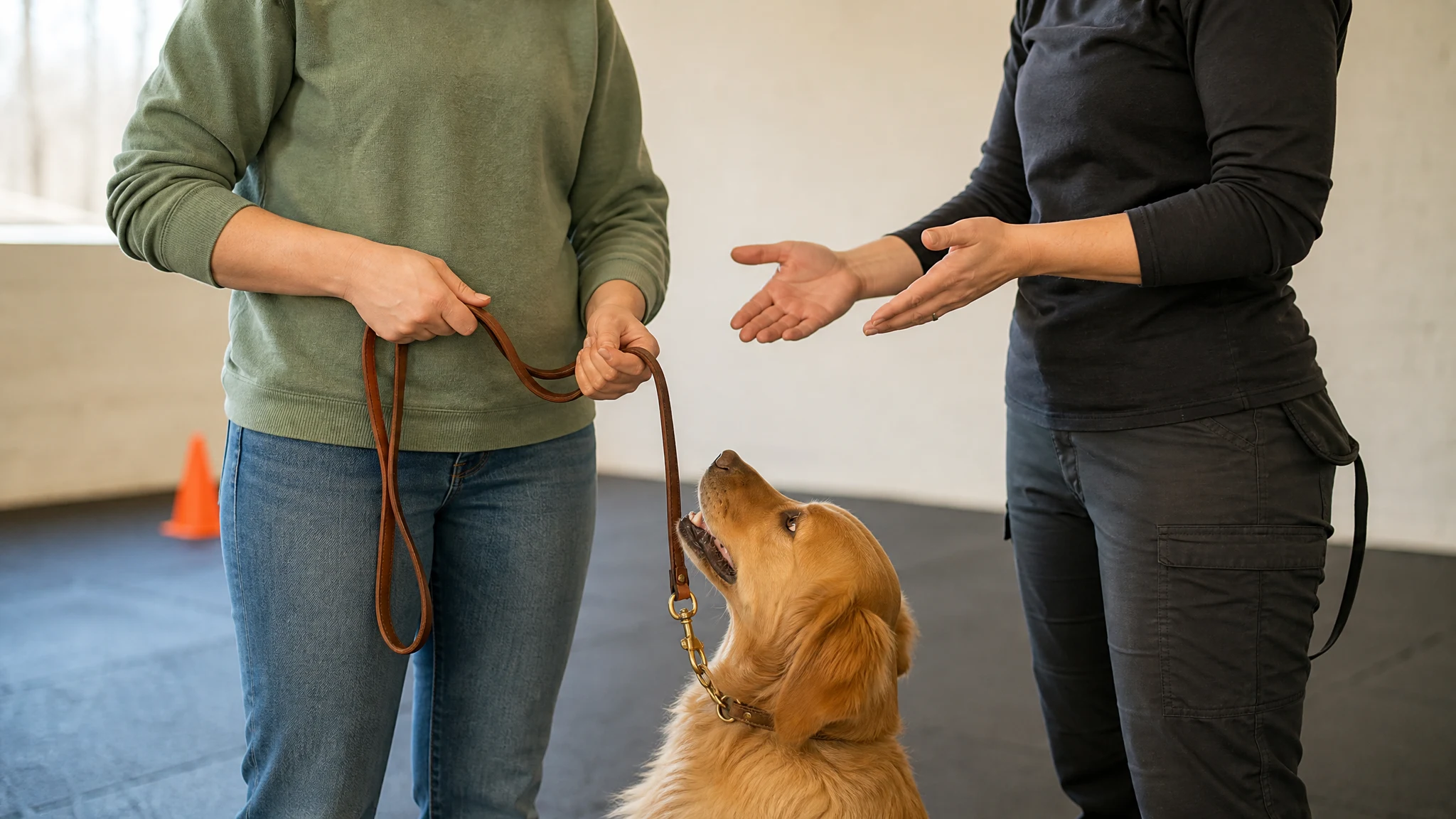
General training information. For aggression, sudden behavior changes or health concerns, see your veterinarian first.
If you live in Anaheim and want help with a new puppy, a dog that pulls on the leash, or a dog that barks at every skateboard on the street, you will find a lot of people calling themselves trainers. Some have years of study and a certification. Some have neither. This guide helps you tell the difference.
We explain what the common credentials mean, list the certified trainers we could verify in the area, and give you a checklist of questions to ask before you book anyone. We do not rank anyone. A fair comparison here means showing you what is known and what you still need to check yourself.
Dog training is not a regulated profession
Anyone can print business cards that say "dog trainer." Dog training is generally an unregulated field, which means there is no single license you must hold to teach classes or take private clients. That is why a certification from an independent organization is useful. It is one way to see that a person has been assessed by someone other than themselves.
A certification is not a guarantee of a good fit. It tells you a trainer met a standard. It does not tell you whether their style suits your dog or whether they communicate well with you. Treat it as a starting point, then ask questions.
Anaheim dog owners also have a separate set of rules to follow no matter who trains the dog. OC Animal Care, which provides field services for Anaheim, summarizes Orange County Code 4-1-45: on public property a dog must be on a substantial chain or a leash of 6 feet or less, under the charge of a competent person. Designated dog parks are the lawful off-leash exception. A good trainer will teach you skills that work within that rule, such as loose-leash walking and a reliable recall.
What the common credentials mean
You will see a handful of acronyms. Here is what each one stands for. For the exact requirements, such as exams, education and continuing education, read the issuing organization's own website, because those details change and we do not want to guess at them.
CCPDT
CCPDT stands for the Certification Council for Professional Dog Trainers. It is an independent certifying body, not a trainer's job title. It keeps a public certified dog trainer directory for California that covers three credentials: CPDT-KA, CPDT-KSA and CBCC-KA.
CPDT-KA
CPDT-KA stands for Certified Professional Dog Trainer, Knowledge Assessed. It is issued through the CCPDT. The "knowledge assessed" part means the trainer was tested on what they know. It does not, by itself, tell you how they handle a nervous dog in a real session, so watching a class or asking about their methods still matters.
CPDT-KSA and CBCC-KA
These two also appear in the CCPDT directory. CPDT-KSA is the Skills Assessed version of the trainer credential. CBCC-KA is a behavior consultant credential, Certified Behavior Consultant Canine, Knowledge Assessed. Check the CCPDT site for what each one requires.
KPA-CTP
KPA-CTP stands for Karen Pryor Academy Certified Training Partner. It comes from a specific school that teaches reward-based training. It is a graduate credential from that program, not a state or national license. We did not find a KPA-CTP in Anaheim, so check the Karen Pryor Academy's own directory if you want to look for one.
IAABC
IAABC stands for the International Association of Animal Behavior Consultants. It is a professional association that certifies behavior consultants. This matters most for problems like fear, reactivity and aggression, where a general obedience class is not enough. We did not confirm an IAABC certificant based in Anaheim, so check the association's own directory directly.
Certified trainers listed near Anaheim
The four people below appear in the California directory of certified dog trainers kept by the CCPDT. None of them is listed with an Anaheim address. They are in the neighboring cities of Orange, Placentia and Tustin, so think of them as options for a dog trainer near Anaheim, not Anaheim-based trainers. The list page does not show which specific credential each person holds, so ask them or look them up on the CCPDT directory.
| Name | Business | Listed area | Credential information |
|---|---|---|---|
| Debbie L. Perry | Not shown in the directory | Orange, CA 92821 | Listed in the CCPDT directory; specific credential not shown on the list page |
| Amanda K. Farah | Not shown in the directory | Placentia, CA 92870 | Listed in the CCPDT directory; specific credential not shown on the list page |
| Gretchen Mavrovouniotis | Wags & Wiggles, per a DogTrainerLocator listing | Tustin, CA 92780 | Listed in the CCPDT directory; DogTrainerLocator lists CPDT-KA |
| Tamlyn Rika Asari | Not shown in the directory | Tustin, CA 92780 | Listed in the CCPDT directory; specific credential not shown on the list page |
We did not find a certified behavior professional, such as an IAABC consultant, based in Anaheim. For a serious behavior problem, check the CCPDT directory for the CBCC-KA credential and the IAABC's own directory.
Pros and cons of each listing
We have not met, watched or reviewed any of these people. These notes come only from what the directory shows, so they are about information, not quality.
Debbie L. Perry (Orange)
Pros: Listed in the CCPDT directory, so there is an independent record. Orange borders Anaheim, so the drive is short for many owners.
Cons: No business name or specific credential is shown, so you will need to ask. Services, prices and class formats are not listed.
Amanda K. Farah (Placentia)
Pros: Listed in the CCPDT directory. Placentia is close to the northeast side of Anaheim.
Cons: Same gaps: no business name, no specific credential shown, and no details on services or prices.
Gretchen Mavrovouniotis (Tustin, Wags & Wiggles)
Pros: This is the one listing with a business attached and a published price list. DogTrainerLocator lists a CPDT-KA credential, and the CCPDT directory lists the name.
Cons: The CCPDT list page does not show the credential letters, and the business page does not show per-trainer credentials, so confirm who will actually teach your class. Tustin is farther from many Anaheim neighborhoods.
Tamlyn Rika Asari (Tustin)
Pros: Listed in the CCPDT directory, which gives you an independent starting point.
Cons: No business name, specific credential, services or prices are shown. Tustin is farther from many Anaheim neighborhoods.
What one nearby business publishes
Wags & Wiggles, with locations in Tustin and Rancho Santa Margarita, publishes puppy class prices on its own site. The page lists a first class free, a single class at $60, a 4-class pack at $200, a 6-class pack at $300 under the AKC Star Program, and a 4-class pack plus one in-home private lesson at $395. Prices can change, so confirm them with the business before you book.
The same page lists entry requirements for puppy class. Puppies should be 8 weeks to 5 months old and have been with you at least 7 days. They need at least one Bordetella and at least one DHPP (distemper and parvo) dose, plus a clean fecal test. The business's page elsewhere says 9 weeks, so confirm the age cutoff with them. We found no published prices for the other three trainers, so ask each one directly.
Who may fit which situation
We are not naming a top pick, because the information available does not support one. These are starting points matched to common needs.
| Your situation | What to look for | Where to start |
|---|---|---|
| New puppy, first group class | A published class format, a clear vaccine policy, and a price you can see up front | Wags & Wiggles publishes both; confirm the age cutoff and who teaches |
| Adult dog with basic manners to learn | A certified trainer who explains their methods and offers a trial session | The CCPDT directory entries for Orange, Placentia and Tustin |
| Leash pulling on Anaheim sidewalks | Practice in real settings and a plan that fits the 6-foot leash rule | Any certified trainer; ask how they teach loose-leash walking |
| Fear, reactivity or aggression | A veterinarian first, then a certified behavior professional | Your veterinarian, then the CCPDT (CBCC-KA) and IAABC directories |
| Barking complaints from neighbors | A plan to reduce the cause, such as boredom or alerting, plus a vet check | A certified trainer, plus OC Animal Care's complaint information |
A checklist of questions to ask any trainer
Ask these before you pay or hand over your dog. A good trainer will be glad you asked.
- Which certification do you hold, and can I look it up? Ask for the exact letters and the name of the issuing organization, then check the directory yourself.
- Is the certification current? Certifications are usually renewed. Ask when yours was last renewed.
- What methods do you use? The American Veterinary Society of Animal Behavior (AVSAB) supports reward-based training. A good answer involves rewards, management and patience.
- Do you ever use shock, prong or choke collars, or physical corrections? If the answer is yes, walk away. Also be wary of talk about "dominance," alpha rolls or scruffing.
- Who will actually work with my dog? Make sure the person you are vetting is the person teaching.
- What happens in a typical session? You should hear about coaching for you, not just handling your dog.
- Can I watch a class first? Seeing the dogs and handlers is the best preview you can get.
- What are your vaccine and health requirements? Puppy classes commonly require vaccines. Make sure the policy matches what your veterinarian advises.
- What do you charge, and what is included? Ask about package terms, cancellations and refunds in writing.
- How do you handle a dog that is scared or overwhelmed? You want to hear about giving the dog space and going slowly.
- What results should I expect, and how long might it take? Be cautious of anyone who promises guaranteed results. Every dog learns at a different pace.
- When would you refer me to someone else? A trainer who knows their limits will send you to a veterinarian or behavior professional when needed.
Local things a trainer should help you with
A trainer who works with Anaheim dogs should be comfortable with the realities of living here. Here are a few worth raising.
Dog park manners. The Anaheim dog parks we found listed through Enjoy Orange County include Olive Hills Dog Park, Maxwell Dog Park, La Palma Park Dog Park and Jacaranda Park Dog Park. Most list separate small and large dog areas. Hours and addresses came from a secondary directory, so check with the City of Anaheim before you go. A recall that works around other dogs is a skill worth practicing.
Heat. OC Animal Care warns that asphalt can burn a dog's paws. At a 77 degree air temperature the asphalt can already be 125 degrees, and skin damage can occur in 60 seconds. It also advises never leaving a pet in a car and always providing water and shade. A trainer can help you schedule practice for cooler hours.
Wildlife. OC Animal Care lists coyotes and snakes among the wildlife residents may see, and bobcats, foxes and mountain lions near open spaces. A solid "come" and "leave it" help keep your dog close.
Barking. OC Animal Care lists Anaheim under Adopted Ordinance Cities for barking dog complaints. It describes a barking dog as one that barks incessantly for 30 minutes or more in any 24-hour period, or intermittently for a total of 60 minutes or more in 24 hours. Complaints go to the OC Animal Care Barking Dog Program at (714) 796-6442. Fine amounts were not published on the pages we reviewed, so ask the agency.
Licensing and rabies. OC Animal Care says every dog 4 months or older must be licensed, the license renews every year, and a current rabies vaccination certificate is required to buy one. Spayed or neutered dogs get a reduced fee. For the fee amounts, check with OC Animal Care. On rabies, the California Health and Safety Code section 121690 requires a licensed veterinarian to vaccinate a dog after it is 3 months old.
When to see a veterinarian first
If your dog has a sudden behavior change, seems to be in pain, or has a medical emergency, see a veterinarian before any training. Pain and illness can look like bad behavior.
If your dog has bitten or threatened a person, see a veterinarian and bring in a certified behavior professional. Do not treat that as an obedience problem. California also has rules on potentially dangerous dogs. OC Animal Care points to Orange County Code 4-1-23 and 4-1-95, and California Food and Agricultural Code 31602. Check with the agency if you think they may apply to you.
Our verdict
We cannot name a single winner, and we would be wary of any page that does. The information available to us shows four certified trainers listed near Anaheim, none of them based in the city, and no confirmed behavior professional in Anaheim itself. That is a thin picture, and it is better to say so than to fill it in.
Here is the reasoning we would follow in your place. First, confirm the credential on the issuing organization's own directory, not just on a trainer's flyer. Second, favor a trainer who is open about reward-based methods and lets you watch a class. Third, weigh distance and cost honestly, because a trainer you can reach every week will help you more than a famous one across the county. Fourth, if the problem involves fear or aggression, go to your veterinarian and a certified behavior professional before a general class.
If you are looking for the best dog trainers in Anaheim, the most reliable approach is to build your own shortlist from the directories, ask the questions above, and trust how the trainer treats your dog during a trial session. A kind, patient trainer with a verified certification is a strong place to start.
Sources
- CCPDT, Certified Dog Trainer Directory, California
- Wags & Wiggles, puppy class page
- OC Animal Care, OC Pet Laws
- OC Animal Care, Barking Dog & Animal Nuisance Complaint Process
- OC Animal Care, Be Careful, the Ground May Be Hot!
- OC Animal Care, Wildlife Information
- California Health and Safety Code section 121690
- Enjoy Orange County, Dog Parks